
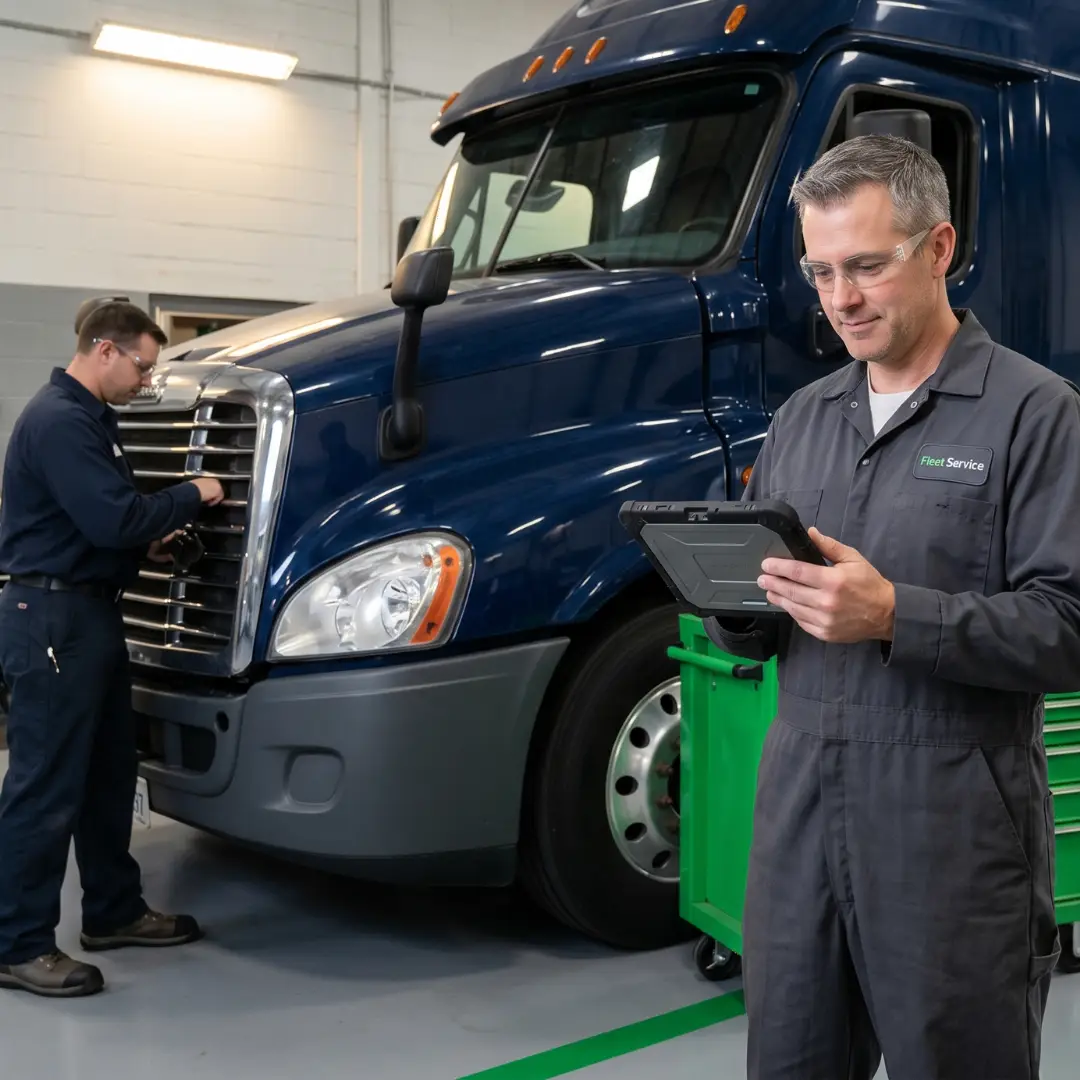
The Cost of Idling
A typical Class 8 truck burns 0.8 gallons per hour while idling. Multiply that by 1,000 to 1,800 hours a year, the average number of idle hours for sleepers, and you’re looking at $3,500 to more than $6,000 in fuel costs per truck, per year, burned while your trucks aren’t even moving.
Many fleets have something in place to address their idling: APUs, bunk heaters, factory idle management systems, or some combination of them. Most fleet leaders, when you ask them about idle management, will tell you they’ve got it handled and keep moving on.
Given where operating costs are headed in 2026, it’s worth asking whether “handled” and “optimized” mean the same thing. In my experience, they usually don’t.
This guide breaks down the primary idle management solutions available to heavy-duty fleets today and provides a framework for evaluating what’s actually working for your operation.
Why Idle Management Gets Overlooked
When ATRI reports that fleet operational costs surged more than 22% over a two-year period, the steepest climb in their 16-year history of tracking it, the instinct is to look at the biggest numbers first. Fuel spend. Insurance. Equipment costs. Driver wages. Those are the line items that get calendar time.
Idle management rarely makes that list. Not because it’s a small problem, but because most fleets already have an answer for it, and that answer closes the conversation. You have APUs. Box checked. Move on.
The trouble is that “we have APUs” is not an idle management program. It’s a hardware decision. Hardware alone, however well-chosen, doesn’t account for how consistently it’s used, whether it actually fits the duty cycle it’s serving, what it’s costing to maintain, or whether drivers are working with it or around it. Because fleets have a solution for it, idle time doesn’t get much attention.
Meanwhile, the cost accumulates. A fleet of 100 trucks could be burning through $350,000 to $600,000 a year in idle fuel alone, before the maintenance costs that come with it. Most of that never gets traced back to idling; it shows up as DPF repairs, elevated oil change frequency, and aftertreatment wear on invoices that don’t say “idle” anywhere.
The other reason idle management gets deprioritized is that it requires buy-in from drivers, and that’s a much harder conversation than swapping a fuel supplier or renegotiating a lane rate. We’ll come back to that.
What Idle Time Is Actually Costing Your Fleet
Before evaluating any solution, it helps to look at what the numbers actually say. Here are the stats:
- A typical Class 8 truck idles at approximately 0.8 gallons of diesel per hour.
- Sleeper tractors log approximately 1,000 to 1,800 idle hours per year, depending on climate, duty cycle, and driver behavior.
- When diesel is $5, that translates into annual idle-related fuel costs of $3,500 to more than $6,000 per truck.
- Fuel accounts for roughly 20% to 25% of total fleet operating costs, second only to driver wages.
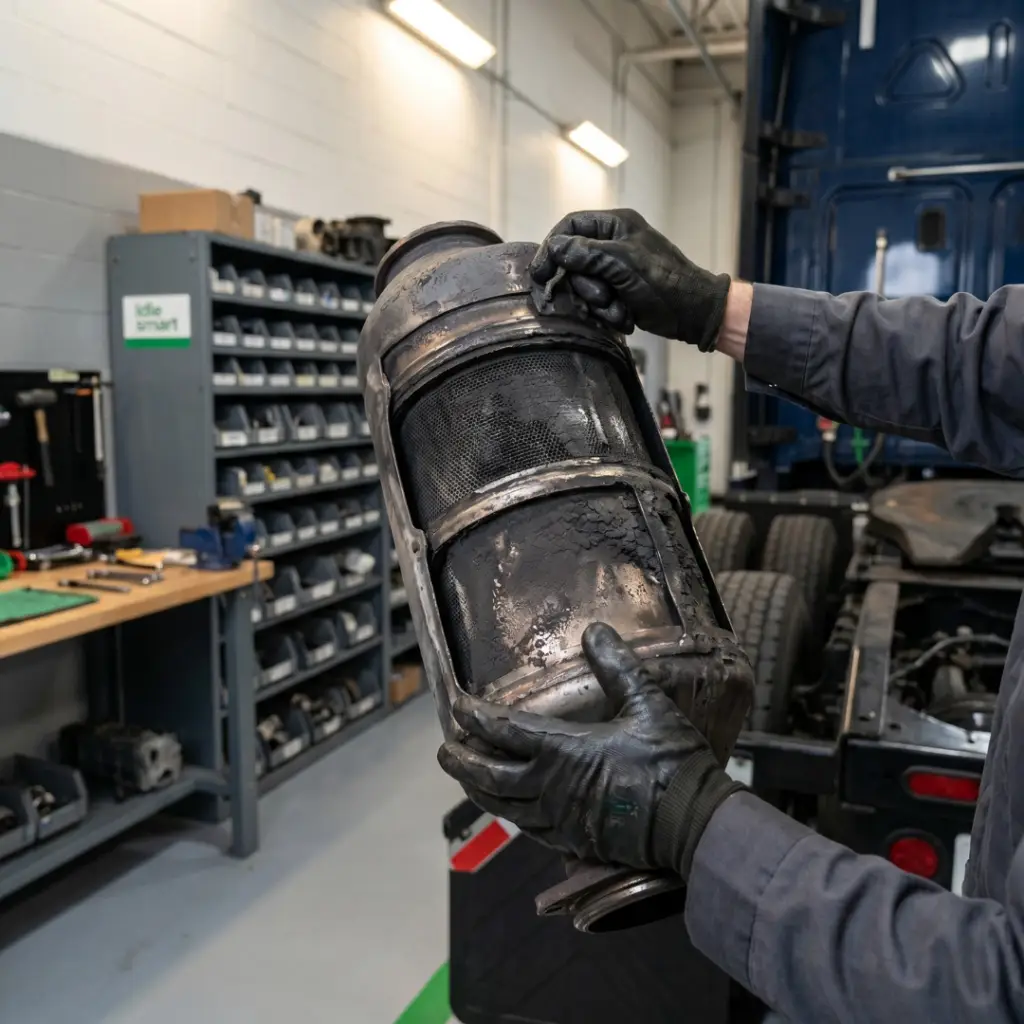
Scale that to a 100-truck fleet and you’re potentially looking at $350,000 to $600,000 in fuel burned while trucks sit still. That’s before you factor in what prolonged idling does to your engines. Idle hours accelerate DPF wear, increase oil change frequency, and strain aftertreatment systems in ways that show up as maintenance costs, costs that rarely get traced back to idling because they’re buried in repair invoices.
The 6 Main Idle Management Options
There’s no shortage of options on the market. Here’s an honest breakdown of each, including where they work well and where they fall short.
| Solution | Best For | Key Advantages | Limitation |
|---|---|---|---|
| Diesel APU | OTR fleets with high idle hours and no existing solutions | Proven full-comfort solution; handles heating and cooling | High upfront cost; adds 400–550 lbs.; ongoing maintenance required. Payback depends heavily on diesel price and idle hours |
| Electric APU (eAPU) or Battery APU | Sustainability- focused fleets; reducing fuel consumption | No fuel burn while running; quieter; less maintenance than traditional APUs, can save up to 2,500 gallons/truck/year | High upfront cost; slower payback; mixed driver satisfaction; requires proper battery conditioning |
| Bunk heater (fuel-operated) | Cold-climate fleets; cost-constrained operations | Low cost; faster payback than APUs; lighter weight, simple to maintain | Heat only: does not address cooling needs. Requires regular maintenance. Uses fuel. |
| Idle timers / auto-shutdown | Compliance- focused fleets; cost-constrained operations | Low or no additional cost; included in truck purchase. Includes preset parameters. | Unique to each OEM. Driver comfort trade-offs are significant; bypass attempts are common without proper pairing. |
| OEM / factory idle management | Single-OEM fleets with newer equipment | Factory-integrated; no additional hardware required | Limited customization; OEM-dependent; not standardized across mixed fleets. |
| Automatic engine management | Multi-OEM fleets; fleets layering solutions; large fleets | Standardizes idle data across OEMs, customizable, minimal hardware, pairs well with other solutions | Driver communication and proper parameter configuration needed to deliver full results. |
NACFE found that a combination of solutions is the most common arrangement. For example, combining a fuel-operated heater, an automatic start/stop system, and basic insulation could achieve most idle management benefits at roughly one-third the cost of a diesel APU. Conversely, a fleet operating in extreme climates might be best served by both an electric APU and an automatic engine management system, using the eAPU for comfort, and the latter to prevent dead eAPU batteries in extremely hot or cold environments.
The right stack depends on your duty cycle, your routes, and, critically, your drivers.
The Key Variable Is Driver Adoption
Now, let’s bring it back to drivers.
I’ve seen it more times than I can count: a fleet buys technology that honestly makes sense for them, installs it across their trucks, and six months later, their idle hours have barely improved. When they pull the data, they often find that drivers are working around it or don’t know how to use the technology.
“Often, when we dig into why a fleet isn’t seeing the results they expected, the answer is the same: drivers weren’t consistently part of the conversation and/or given the resources they need to succeed. You can’t install your way out of that.”
— Sara Young, VP of Customer Success and Marketing
Drivers idle because they need heating or air and power for CPAP machines, electronics, and refrigerators during mandatory rest periods. It’s a basic quality-of-life expectation for someone spending weeks at a time in a sleeper cab. Any idle management program that doesn’t put driver comfort and adoption first will probably be bypassed by a good chunk of drivers.
NACFE’s 2025 research is unambiguous on this: “Driver comfort and training are pivotal. Get buy-in from drivers” is listed as a baseline best practice. It’s the starting line, not the finish. The questions worth asking about any system aren’t just about cost and fuel savings. Does it require driver action, or does it work automatically? Can drivers adjust their comfort settings within reasonable parameters, or are they locked out? A driver who feels like the system is working against them will find the override, and you’ll never know it happened.

Fleets that get this right treat it as a partnership. Some tie idle-reduction goals to driver performance scorecards. NACFE cites fleets allocating as much as 30% of a driver’s score to idle metrics and pairing that with genuine comfort alternatives. One carrier that weighted 30% of its driver score on idle reduction did a rapid eAPU rollout at the same time, cutting average idle time by double digits and saving more than $2 million in fuel costs in the first year.
Driver retention and idle management are connected in ways that don’t always show up in the cost-benefit analysis but absolutely show up in the operation. A program that keeps drivers comfortable, doesn’t feel punitive, and gives them resources when they need them doesn’t just reduce idle time, but also turnover. It becomes a retention tool, not just a cost-control mechanism.
How to Evaluate Your Idle Management Program
Regardless of your existing idle management program, you can start evaluating your setup by asking these questions:
- What is the maintenance burden of your current idle management equipment?
APUs and eAPUs require regular service. If your shop is already stretched, that burden matters. Add up actual labor hours and parts costs per unit per year, not just the purchase price.
- What is your real ROI, and are you satisfied with it?
Do you know your actual idle hours by truck? Does your current technology give you visibility into that data? If you’re estimating, you’re probably underestimating the cost.
- What do your drivers need, and what happens when the system doesn’t deliver it?
Driver bypass is common. Idle timers get overridden. eAPUs die in the middle of the night. If drivers have workarounds for your systems, that’s a signal worth investigating before assuming the technology isn’t working.
- What is the driver comfort and satisfaction impact of your current solution?
Ask your drivers. Their experience directly affects how consistently any solution performs and, by extension, whether it delivers the savings you planned for.
- Does your team require specialized training to maintain your current equipment?
Some idle management technologies require manufacturer-certified technicians. That’s a hidden cost. Evaluate whether you’re building a parts and labor dependency into your program.
- How scalable is your current solution, and does that match your fleet’s trajectory?
A solution that’s a perfect fit for 50 trucks may not scale cleanly to 200. Consider total installation time, configuration complexity, and whether you can manage it across a mixed OEM fleet without adding headcount.
No program is perfect. The goal isn’t to swap everything out, but rather to understand where the gaps are so you can make targeted decisions, not expensive ones.
The Bottom Line
Idle management isn’t a one-size-fits-all problem. The right combination depends on your duty cycle, your climate, your fleet mix, and, more than anything else, your drivers.
What I can tell you after 30 years in this industry is that spot rates will spike and drop, tariffs will come and go, and fuel prices will do what fuel prices do. The best thing you can do to weather any changes headed toward the industry is to control what you can, and bank on consistent savings over temporary gains.
Want to walk through your fleet’s idle management strategy?
Still have questions? Here’s what I hear most often.
Frequently Asked Questions
What is automatic engine management?
Automatic engine management is a software-driven system that monitors cab temperature and battery levels and automatically starts or shuts down the engine to maintain driver comfort and prevent dead batteries without requiring drivers to do anything.
Unlike factory idle timers, which cut the engine on a fixed schedule regardless of conditions, automatic engine management systems adjust based on real-time inputs like ambient temperature and battery state. They can also be configured across 30 or more parameters, making them compatible with mixed-OEM fleets where factory settings vary from one truck to the next. For fleets that already have APUs or bunk heaters, automatic engine management works alongside them, protecting battery charge, reducing unnecessary engine runtime, and filling the gaps they leave behind.
Is an APU enough for idle management?
For many fleets, a diesel APU is a reliable, proven solution for driver comfort. However, they certainly come with drawbacks. APUs are heavy, require regular maintenance, and their payback timeline is slow as they are highly sensitive to diesel prices and idle hours. eAPUs are becoming more popular and use less fuel as they run on battery power, but they still require some maintenance. With tariffs and other volatile economic conditions, the price of parts for this equipment, especially lithium batteries, is sharply rising.
NACFE’s 2025 report suggests that the most effective programs combine complementary technologies rather than relying on a single solution. An APU paired with an automatic engine management system often delivers better outcomes and lower total cost than an APU alone: the APU handles comfort, and the engine management system prevents the scenarios where APUs fall short, like dead batteries from an eAPU losing charge overnight.
What’s the ROI on an electric APU?
eAPUs can save up to 2,500 gallons of diesel per truck per year. At current diesel prices, that translates to $4,500 to $6,000 in annual fuel savings per truck. Pricing typically runs $11,000 to $15,000, with newer models with longer-lasting batteries costing more. Typically, payback for these devices is in the 2- to 3-year range for high-idling trucks, though climate, duty cycle, and pairing with other solutions also affect the math.
Electric APUs don’t require filters, diesel, or the maintenance of traditional APUs, but they still need proper battery conditioning to maintain a long lifespan. Drivers have historically experienced issues with eAPUs dying during the night, even with the promise of a full 8-10 hours of charge, so there is sometimes mistrust and reluctance from their end.
As lithium-ion batteries become more expensive, the ROI of battery APUs will become less attractive, so considering potential future cost increases will help you realistically evaluate their ROI for your fleet.
How do I get drivers to reduce idle time?
The most effective approach pairs real comfort alternatives with clear communication and, where appropriate, performance incentives. Drivers idle because they need heat, AC, and power, so any idle-reduction program has to address those needs first. Fleets that allocate a portion of driver performance scores to idle metrics, and back that up with technology that actually keeps cabs livable, consistently see the biggest reductions. The key is that drivers need to feel supported, not restricted. When drivers have reliable comfort, understand the goals, and have someone to turn to when something isn’t working, idle reduction stops being an enforcement issue and starts being a shared responsibility.