

Key Takeaways
- Normal parasitic draw for a Class 8 truck is 50–80 milliamps.
- The most common culprits of parasitic drain are aftermarket accessories wired to constant power, not necessarily electrical failures.
- A single no-start event costs an average of $800 per event.
- Automated battery protection prevents dead batteries caused by parasitic drain.
Parasitic Drain in Trucking Fleets
A truck that starts every morning without fail is the backbone of efficient fleet operations. Yet parasitic battery drain quietly threatens that reliability, pulling power from truck batteries even when the ignition is off. This hidden current draw can turn a routine overnight park into an expensive no-start event.
I’ve been in this industry for 30 years, starting as a dispatcher, eventually running my own operation, and have spent the last several years working with fleets across North America. Battery-related no-starts are among the most consistent, preventable, and underestimated cost drivers I see, and they’re getting worse as trucks carry more electronics.
Let’s dive into the details of where parasitic drain comes from and how fleets are solving it today.
What’s A Normal Amount of Drain?
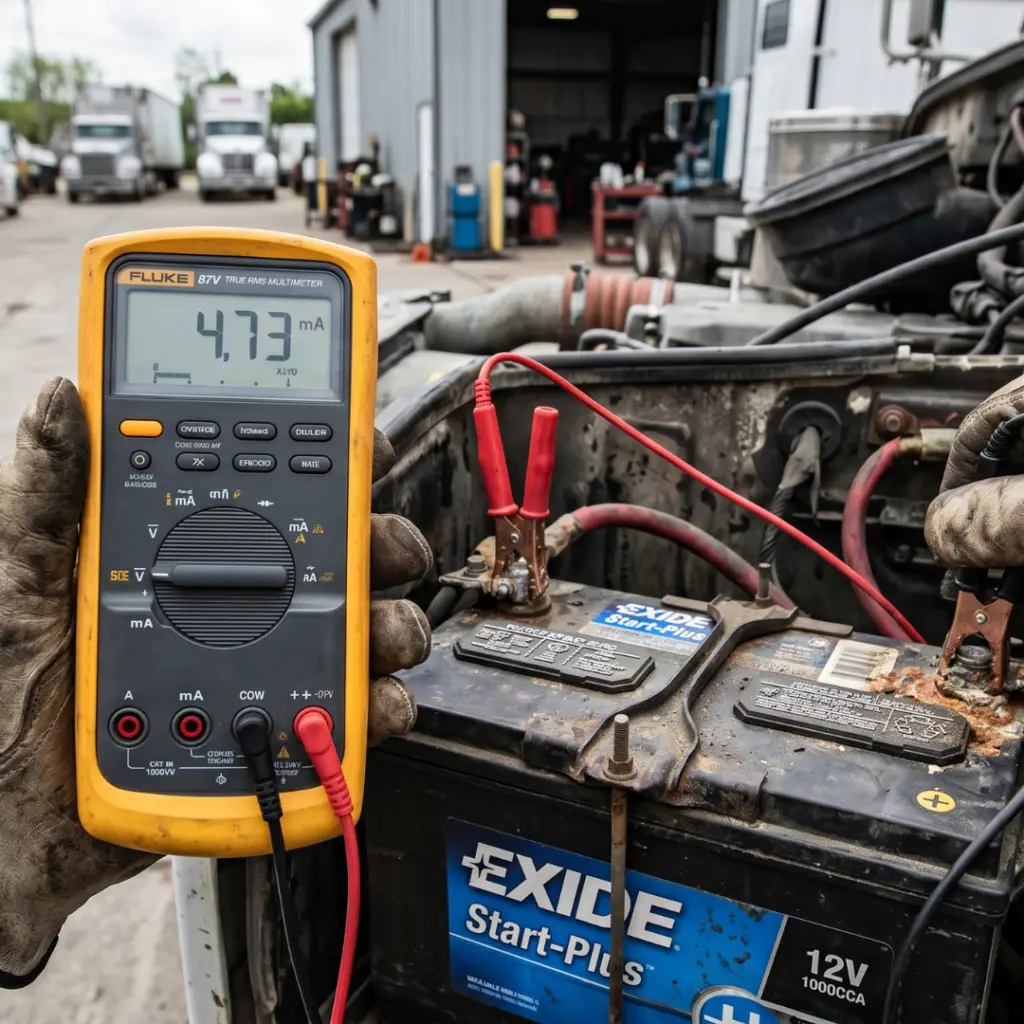
Every Class 7–8 truck draws some current after the key is off. ECM memory, ELD systems, and telematics units all need a trickle of power to retain settings and stay connected. According to Fleet Maintenance, an acceptable draw for a modern commercial truck is generally 50–80 milliamps once the system fully enters sleep mode. Some highly equipped trucks may run a little higher; that’s fine.
The problem starts when draw climbs into triple digits and stays there. At 200–300 mA, batteries lose meaningful charge over a single shift. Over the weekend, you’re looking at a truck that won’t start on Monday morning.
For OTR fleets, hotel loads from tech like gaming systems, refrigerators, and CPAPs add a significant draw on top of the baseline. Most electric APU systems deplete their battery banks within 4–6 hours of rest, at which point the driver either manually starts the truck to recharge or wakes up to a dead system. Daycabs don’t have to worry about hotel loads, but they tend to accumulate aftermarket accessories and run shorter routes with more frequent starts, both of which stress batteries in different ways.
Warning Signs of Parasitic Drain
Anything above 100 mA in a daycab warrants investigation. At this level, your batteries will discharge noticeably over a weekend. Draws exceeding 200 mA can drain batteries overnight, leaving you with no-start situations after a single shift.
Track your battery voltage over time. Healthy batteries should maintain 12.4V or higher after sitting for 24 hours. If the voltage drops below 12.2V overnight, it’s likely caused by excessive battery draw.
What Are the Most Common Causes of Battery Drain?
Modern cabs contain dozens of electrical systems that can draw power around the clock.
Aftermarket Accessories and Improper Wiring
GPS units, dash cameras, and CB radios often connect directly to battery power rather than switched circuits. If the installer didn’t wire these accessories through the ignition switch, they’ll draw power around the clock. This single issue causes the majority of parasitic drain problems in commercial vehicles.
Faulty Relays and Control Modules
Relays act as electrical switches for various systems. When a relay sticks in the closed position, it keeps sending power to a circuit that should be off. Similarly, body control modules and engine control modules can malfunction and fail to enter sleep mode properly.
Trailer Circuit Issues
The charging circuit between your truck and trailer doesn’t always disconnect cleanly. A faulty trailer plug or corroded connections can allow power to flow backward, draining your tractor batteries through the trailer connection.
Corroded Terminals and Poor Connections
Corrosion creates resistance, and resistance creates heat and power loss. Dirty or loose battery terminals force your charging system to work harder while also allowing small current leaks that contribute to battery drain over time.
Rodney Wilson spent 30 years managing private fleets before joining Idle Smart. He’s seen this pattern play out hundreds of times: “Nine times out of ten, it’s something simple like an accessory that was never wired correctly. Fleets spend more time dealing with the dead battery than they ever would have spent preventing it.”
What Maintenance Practices Reduce Parasitic Drain Risk?
Building the right maintenance habits into your routine minimizes parasitic drain problems before they cause no-starts. Here are my recommendations:
- Clean terminals and inspect connections at every PM interval. Baking soda and water neutralize acid buildup; dielectric grease on the terminals after cleaning prevents it from coming back. Tight, clean connections remove resistance from the equation.
- Audit your aftermarket accessories. Document what’s installed on every truck and verify each device connects through a switched circuit rather than constant battery power. If it has to stay on constant power, make sure it has an automatic shut-off. This one step eliminates the majority of parasitic drain problems.
- Add a parasitic draw test to your routine service intervals. It takes minutes with a multimeter. Do it during oil changes and track the readings over time. Gradual increases over time can tell you something’s going on.
- Consider a low-voltage disconnect (LVD) as a safety net. An LVD monitors battery voltage and automatically cuts power to non-critical loads before the battery drops past the point of no return. It doesn’t fix the underlying problem, but it keeps your truck startable while you troubleshoot.
- Invest in Driver Training: Drivers play a crucial role in preventing parasitic drain. Train them to disconnect accessories before shutdown, close doors fully, and report any electrical anomalies. Remind drivers that this isn’t just a random “to-do”; it keeps the wheels turning so they can keep earning.
Rodney puts it plainly: “I’ve seen plenty of folks think they can manually manage batteries until they’re stuck sending a guy out to the yard every night just to start trucks. You can do that, or you can fix it.”
How Much Does Parasitic Drain Cost?
The financial impact of uncontrolled parasitic drain adds up fast. When it leads to a no-start, each event triggers a cascade of costs: emergency service calls, missed deliveries, driver downtime, and potential customer penalties. Industry estimates suggest fleets lose over $800 per event when a truck sits idle waiting for a jump-start. For some fleets, it costs closer to $1,400.
Beyond the immediate cost, repeated deep discharges permanently damage your batteries. Lead-acid batteries lose capacity each time they’re drained below safe levels. What started as a simple parasitic draw becomes a cycle of premature battery replacements.
The main issue is the unpredictability. A truck that started fine yesterday may not turn over tomorrow, making scheduling difficult and eroding confidence in your equipment.
Where Fleets Are Heading
As fleets recognize how expensive reactive battery management is, they are deploying LVDs, solar charging panels, master disconnect switches, and telematics-based voltage monitoring more aggressively.
The next step, and where the industry is moving, is automatic intervention: systems that monitor battery state in real time and respond before a problem develops, without adding steps for drivers. This is exactly what Idle Smart does—it continuously monitors voltage and automatically starts the engine to charge the batteries. Even when the keys are out or off, or drivers are away for the weekend, you can be confident your trucks will start.
Mark Prusak, Assistant Vice President at Transervice Logistics, put it well:
“No-starts aren’t just expensive, they hurt relationships with our customers and delay getting products to store shelves. With Idle Smart, I’m confident the batteries are charged and ready to go. Even when drivers are home for their days off, they know their trucks will start when they get back. That kind of reliability is how we provide the level of service our customers expect from us.”
That’s the standard fleets are holding themselves to now.
If parasitic drain is a challenge for your fleet, our team is here to help.
Vice President of Sales
FAQs About Parasitic Drain
How long should I wait before testing parasitic draw?
Wait at least 20 to 45 minutes after shutdown before testing. Modern trucks have electronic modules that need time to enter sleep mode fully. Testing too soon gives artificially high readings that don’t reflect true parasitic draw.
Can a low-voltage disconnect damage my batteries?
No, a properly configured LVD protects your batteries by disconnecting loads before the voltage drops to damaging levels. The system automatically reconnects when charging restores healthy voltage, preventing deep-discharge cycles that shorten battery life.
How does Idle Smart help prevent battery-related no-starts?
Idle Smart monitors battery voltage in real time and automatically starts the engine when voltage drops toward critical levels. This active intervention keeps batteries charged without requiring driver action. The system works across your entire fleet regardless of truck make or model.
How can I tell if an aftermarket accessory is causing battery drain?
Use the fuse-pull method during parasitic draw testing. When you pull the fuse for a circuit that includes the accessory and the draw drops significantly, that accessory is likely the cause. Verify by disconnecting the accessory directly and retesting.
What’s the difference between a BMS and an LVD?
A battery management system (BMS) monitors battery health and reports data, but typically doesn’t take automatic corrective action. A low-voltage disconnect (LVD) automatically cuts power to protect batteries but doesn’t track or report battery health data. Some fleets use both for monitoring and protection.