

Updated:
Why are fuel efficiency and driver comfort at odds?
Balancing driver comfort with fleet efficiency is a delicate equation. Usually, getting more of one means giving up some of the other.
When trucks are parked overnight, drivers need a comfortable cab to get good rest, which often means idling all night to keep the cab warm or cool. Idling, however, burns fuel, and with diesel over $6 a gallon in recent weeks, that’s hard on the budget.
So, how do fleets keep drivers comfortable without driving up costs?
We’re diving into how much extended driver idling costs fleets, what restricting it costs drivers, what options fleets have today, and how solutions like Idle Smart keep drivers comfortable without racking up fuel costs.
How much does idling cost fleets?
For many fleets, extended idling feels like a necessary evil for driver comfort. Running the engine is the simplest way to keep the cab livable and power everything in it during a rest period. That convenience comes with costs.
Fuel Costs
NACFE estimates a Class 8 truck burns about 0.8 gallons of diesel per hour while idling, which, over a 10-hour rest period, is about 8 gallons. Over a year, that’s 1,000 to 1,800 gallons per truck. That’s $6,300-$11,300 per truck per year at last week’s national average diesel price of $6.29/gal.
For a 100-truck fleet, that’s about $630,000 to $1.13 million per year in idling fuel costs.
Increased Wear and Maintenance
Idling all night also drives up engine runtime, increasing wear and maintenance costs. One hour of idling puts about 25 to 30 miles’ worth of wear on an engine. At 1,000 idle hours a year, that’s 25,000 to 30,000 miles of engine wear per truck each year.
Extended idling also keeps exhaust temperatures too low to burn soot out of the diesel particulate filter (DPF) during normal operation, which leads to more frequent DPF regenerations.
Compliance and Fines
Extended idling can also result in fines. Many states, counties, and cities limit how long a parked truck can idle, and limits, exceptions, and penalties vary by jurisdiction. Some carve out exceptions for sleeper berths or extreme temperatures, and some don’t. Most of those laws are aimed at air quality, and cutting idle time also helps fleets working toward emissions and sustainability goals.
What does restricting idling cost drivers?
Restricting idling can save a ton of fuel, but drivers suffer in stifling hot or freezing cold cabs without other solutions.
Poor Rest
Without another way to heat or cool the sleeper, drivers tend to sleep poorly due to uncomfortable cab temps or because they get up to start the truck repeatedly to keep the cabin comfortable. Rest is critical for safe driving, and NACFE warns that idle strategies that ignore rest, climate control, and power needs struggle to earn driver acceptance.
No-Starts
With the engine off, the truck batteries still power everything the driver uses overnight, like lights, phone chargers, and a fridge. Without an engine to recharge them, they can die before morning. When batteries die and trucks won’t start, drivers get stranded waiting for a jump or a service call instead of driving.
Lost Pay
Many long-haul drivers are paid by the mile, so every hour a truck isn’t moving comes out of their paycheck. If the delay makes them late on a delivery, it can cost them a performance bonus, too. Drivers who can stay on the road and hit their targets are more likely to stay motivated and stay with the fleet, and ATRI has linked higher driver pay to lower turnover.
What idle reduction options do fleets have today?
Even NACFE says no single solution fits every climate and duty cycle. Many fleets find the most success by combining multiple options. Each one has unique upsides, but also has trade-offs:
- Idle shutdown timers: The most common option. NACFE found 83% of the fleets it tracks use electronic engine controls like these. They’re built into most trucks and save fuel, but they can’t restart the engine for heat, cooling, or battery charge.
- Fuel-operated bunk heaters: Burn far less fuel than idling and are among the most widely adopted options. They only heat, so they don’t help on hot nights, and their fans still draw on the batteries.
- Diesel APUs: Heat, cool, and power the cab with the engine off, and can run as long as there’s fuel. APUs typically cost $8,500 to $15,000 per truck, add weight, and need maintenance of their own.
- Electric APUs: Run on battery power and burn no fuel, but cold weather cuts battery capacity, and in extreme heat they may not last a full rest period. When the batteries run out, the driver is back to idling or going without.
- Shore power: Drivers plug in at equipped truck stops and terminals for heat, cooling, and power with the engine off. The catch is finding it. Equipped spots are hard to come by; using them takes route planning, and even then all the spots might be taken, so driver comfort is sometimes a gamble.
- Automatic engine start-stop: Factory-installed or aftermarket systems that start and stop the engine automatically to keep the cab comfortable and the batteries charged. What each system monitors, and how much fleets can adjust it, varies widely from one system to the next. The tradeoff is that the engine stops and starts during the night, particularly if the parameters aren’t configured for the weather.
How does Idle Smart balance driver comfort with fuel efficiency?
Idle Smart is, by definition, an automatic engine start-stop system, but it’s built differently from the factory systems that come installed on most trucks. The system bridges the gap between comfort and efficiency by automatically cycling the engine to protect the truck and conserve fuel for drivers.
Idle Smart automatically starts trucks when:
- The batteries run low
- The engine gets too cold to start reliably
- The cab drifts outside the comfortable range (too hot or cold for the driver)
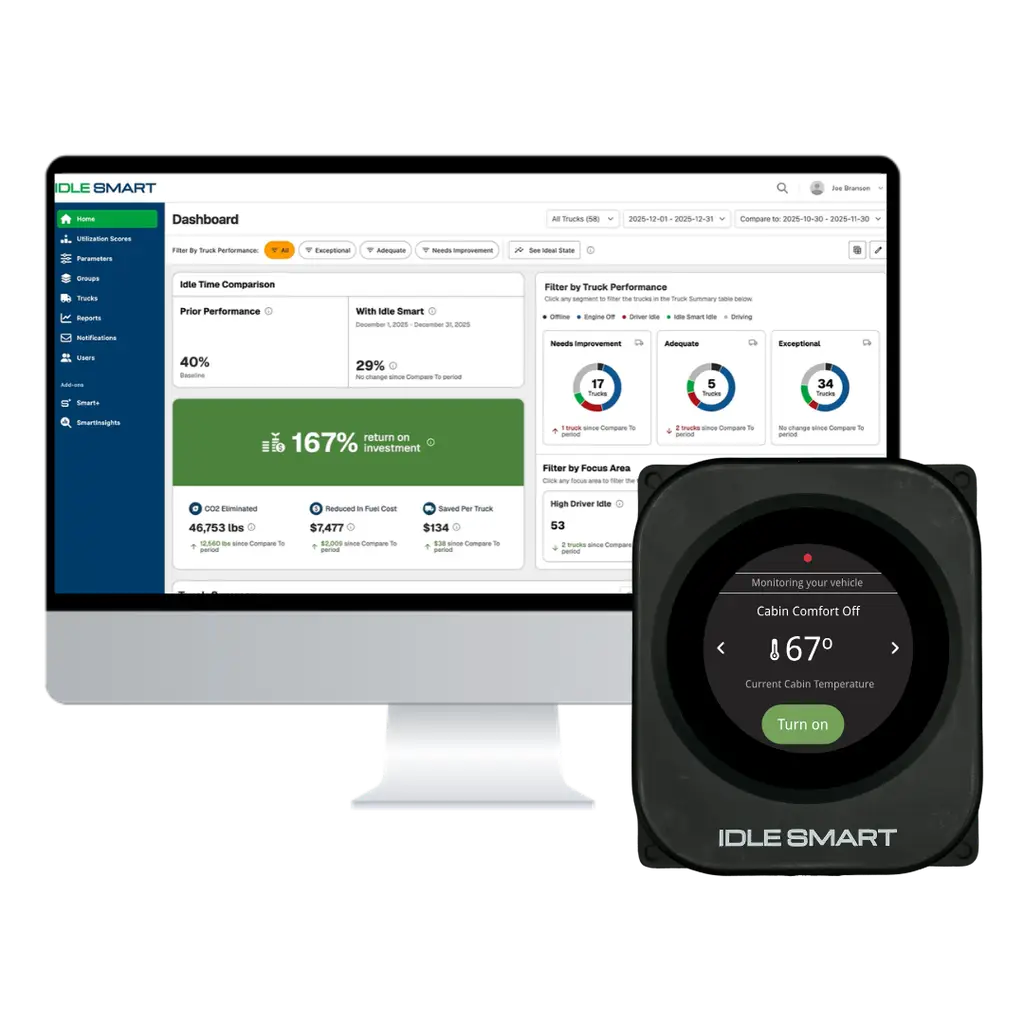
What that looks like in practice:
- Idle Smart automatically arms as soon as the truck is parked without drivers doing a thing. The system’s proprietary technology runs on its own with the key off or out.
- Because Idle Smart operates with the key off, fleets get visibility into key-off behavior.
- Fleets and drivers get control over their settings. Fleets set parameters and temperature ranges in the online portal, and drivers can adjust their cab’s target temperature within that range via the Display.
- It works with equipment fleets that already have:
- Paired with an eAPU: The eAPU handles cab comfort, and Idle Smart runs the engine long enough to recharge the eAPU batteries when they run low.
- Paired with a bunk heater: Idle Smart does what the heater can’t: charge batteries, keep the engine warm enough to start, and cool the cab on hot nights.
The key difference for drivers is that Idle Smart is automatic. It doesn’t require any driver interaction to protect their comfort and their trucks, so they can sleep straight through the night without worrying about a thing.
How can fleets get started with Idle Smart?
The easiest way to get started is to talk with our team. We’ll look at your fleet’s available data, talk through your biggest concerns, learn about your driver experience, and help you figure out whether Idle Smart is the right fit.
From there, installation is simple. Your dedicated Customer Success Manager (CSM) will help you get going and provide the installation resources your technicians need. You can install Idle Smart in your own shop, typically in under two hours, or at a mod center partner like Fontaine Modification or Commercial Vehicle Solutions (CVS).
Your CSM will help you set initial parameters, build a driver engagement plan, and provide recommendations for a successful rollout. After you’re set up, we won’t leave you hanging. Our team provides ongoing support for your techs and drivers, and you can set up regular check-ins with your CSM.
Want to see if Idle Smart is right for you?
FAQ
Should fleets completely restrict idling?
While it depends on the fleet, typically no, not without other driver comfort solutions in place.
Certain states and jurisdictions regulate extended idling, so sometimes it’s legally necessary. However, it’s generally not recommended to completely restrict idling without another way to keep the cabin at a comfortable temperature for OTR drivers. The “right” approach depends on your fleet, but most can cut idling significantly without sacrificing driver comfort with the right mix of settings, driver engagement, and strategic technology investments.
Are fuel efficiency and driver comfort always opposites?
They often seem to conflict, but they don’t have to be one or the other. With the right blend of strategies and technology, fleets can keep drivers comfortable while dramatically reducing idle time.
Does Idle Smart protect batteries over the weekend?
Yes. As long as the safety conditions are met and the fuel level is above 10%, Idle Smart cycles the engine to charge the batteries and warm the engine, even when the truck sits for days. Your fleet can adjust battery and cold-start protection settings in the SmartPortal at any time.
Will Idle Smart start the truck when the hood is open?
No. Idle Smart’s safety conditions require the hood to be closed for the engine to start.