
Key Takeaways
- Diesel APUs typically cost $8,500–$15,000 and add 400–550 lbs. per truck, with scheduled maintenance every 500–2,000 operating hours.
- Electric APUs cost $9,000–$18,000 and depend on battery capacity and charging time to maintain comfort during a full rest period.
- Automatic idle management systems connect to the truck’s ECM, require no separate engine or battery bank, and add no meaningful weight.
- For some fleets, the two approaches work together. Automatic idle management can protect electric APU batteries and extend their effective runtime.
APUs are Important… and Expensive
Most fleets that invested in APUs made the right call for the time. Fuel was expensive, anti-idling regulations were tightening, and drivers needed a reliable way to stay comfortable during rest periods without running the main engine for eight hours straight.
APUs solved those problems reasonably well, but the cost of running a fleet looks different today. Maintenance budgets are under pressure. Payload optimization matters more than ever, and driver retention has become one of the most expensive line items in the business. When you step back and look at the full picture, the question isn’t “do we need idle reduction?” The question is “which approach actually costs us less over time, and which one works better for our drivers?”
What Is Automatic Idle Management?
Automatic idle management is an alternative to APUs that automatically manage engine idling by stopping and starting the engine to maintain safe operating levels. These systems connect to the truck’s engine control module (ECM) and use sensors to track real-time conditions. When conditions like battery voltage or coolant temperature fall outside the fleet’s set range, the system starts the engine to recharge. When it recovers, it shuts off.
For many fleets, automatic idle management delivers comparable fuel savings at a lower upfront cost and without the added weight of an APU.
The goal of automatic idle management is to provide the fuel savings of traditional idle management systems without adding weight to the frame while removing steps for drivers.
Several OEMs and vendors offer automatic idle management solutions. They vary in the number of configurable parameters, over-the-air update capability, and data reporting depth. When evaluating options, it’s worth asking how settings are updated across your fleet, what happens when ambient conditions shift significantly, and whether the system integrates with your existing telematics.
Battery Protection and No-Start Prevention
Dead batteries are among the most common causes of roadside service calls for Class 8 trucks, yet one of the most preventable. Each no-start event costs towing fees, driver downtime, and potentially a missed delivery window.
Automatic idle management systems monitor battery draw from cab accessories in real time and start the engine when the power level falls outside the fleet’s set range. The engine runs until the batteries are sufficiently recharged, then shuts off. This cycle repeats as many times as needed through a rest period or an extended yard stay.
APUs address this differently. Diesel APUs recharge batteries through their own alternators while running. Electric APUs power accessories directly from their battery banks, but those banks must be recharged by the main engine alternator while the truck is in motion or by shore power. If the driving day was short or shore power wasn’t available, battery capacity may not last through the full rest period.
Driver Comfort and Reliability
Driver comfort and driver retention are connected. Replacing a driver costs thousands of dollars in recruiting, onboarding, and lost productivity. Any idle management technology that disrupts rest or creates additional tasks for drivers to manage is a hidden cost.
Both diesel APUs and automatic idle management systems can maintain comfortable cabin temperatures through a rest period.
Diesel APUs have their own engines, which means they still require diesel and come with their own set of maintenance requirements. A belt issue, a fuel system problem, or a missed maintenance interval can take the unit offline, and depending on the severity, lead to days of downtime.
Electric APUs have improved substantially in recent years, with lithium-ion battery banks now offering competitive runtimes under moderate conditions, but they’re still challenged by extreme weather. High heat or deep cold significantly reduces effective runtime, and in some configurations, batteries can deplete before a rest period ends. Managing the state of charge and knowing when to pre-cool the cab adds operational complexity for drivers.
Automatic idle management doesn’t have a separate engine to fail or a battery bank to deplete. These systems typically don’t require maintenance, but some OEM systems require seasonal configuration. For drivers, that generally means fewer interruptions, less downtime, and no additional steps to manage battery levels overnight.
Installation Requirements
Diesel APUs require 6–10 hours of installation labor, though many fleets report it taking longer. The unit mounts on the frame rail and involves wiring, mounting hardware, refrigerant lines, and cab control installation. Some tractors require fairing or fender modifications. Expect shop scheduling and meaningful downtime per truck.
Electric APUs have similar installation complexity: 6–10 hours of labor, frame-rail mounting, electrical integration, and optional add-ons like solar panels or shore power kits. The process is cleaner than diesel since there’s no exhaust routing, but it’s still a significant shop commitment per unit.
Automatic idle management systems generally install much faster. Often, they connect directly to the ECM and require minimal wiring, with no frame-rail modifications or refrigerant lines. Installation time varies by provider and truck configuration, but it can be as short as 1 hour.
Can You Use Both?
Yes, and many fleets do. Electric APUs handle climate control efficiently and produce no direct emissions during use. Automatic idle management protects their batteries and extends effective runtime without driver intervention.
If an electric APU’s battery bank depletes during an extended rest period, an automatic idle management system can start the main engine to recharge it, keeping the APU running and the driver comfortable through the night. This combination addresses one of the primary limitations of electric APUs in extreme conditions without asking drivers to manage it manually.
Which Option Is Right for Your Fleet?
The decision between automatic idle management and APUs comes down to matching the capabilities of each to your operating requirements. Both approaches significantly reduce idling compared to doing nothing, but one may fit your fleet better than the other.
For many Class 8 fleets, automatic idle management delivers the fuel savings, emissions reduction, and driver comfort you need without the complexity and maintenance burden of APU equipment.
Evaluate your routes, regional climate, regulatory environment, and driver retention priorities before making any decisions. The right choice becomes clear when you match technology features to your actual operational needs.
See How Idle Smart Compares
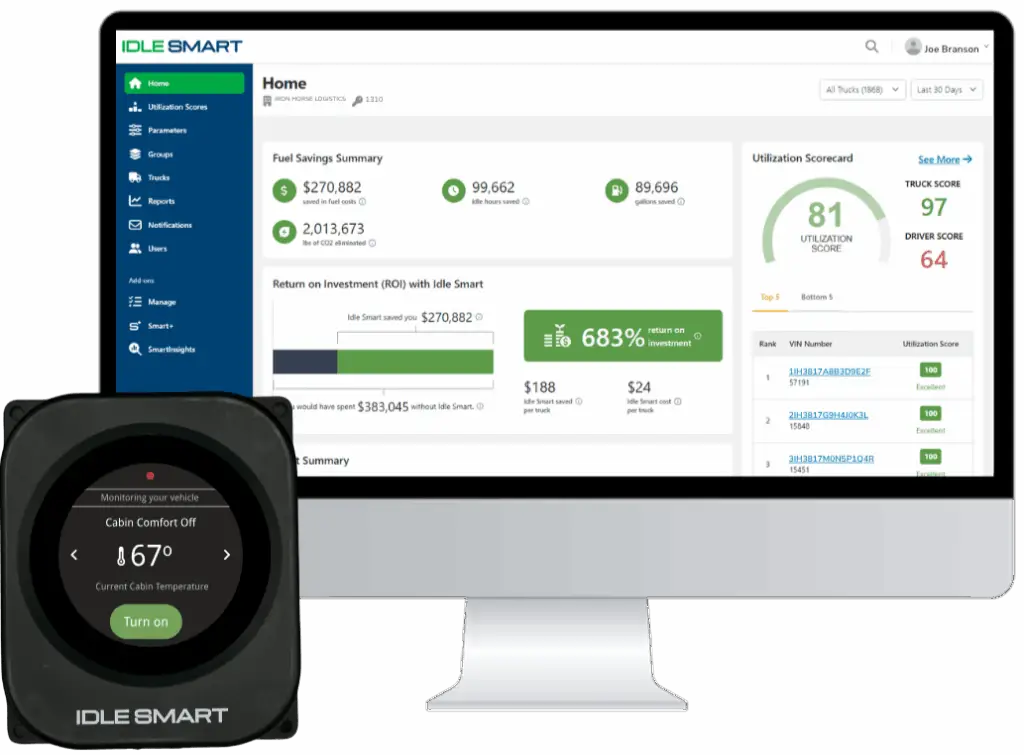
If automatic idle management is on your radar, Idle Smart is worth a closer look. It installs in about an hour, works across all major OEMs, requires no maintenance, and gives your team granular control over your trucks, right from your desk via the online portal.
See what it looks like for your fleet today.
FAQs
What is the difference between automatic idle management and an APU?
Automatic idle management cycles your main engine on and off based on battery voltage and temperature needs. An APU is a separate power unit that runs independently from the main engine.
The key distinction is whether you’re using the truck’s existing engine or adding separate power generation equipment. Each approach has different maintenance requirements, costs, and operational characteristics.
Do APUs require maintenance that automatic idle management systems do not?
Yes, diesel APUs require their own maintenance schedule, including oil changes, filter replacements, and periodic inspections. Electric APUs require battery conditioning and replacement. Automatic Idle Management offers maintenance-free operation, with no batteries or separate engine to service.
This difference compounds over years of ownership, with APU maintenance consuming technician time and parts budgets that automatic idle management avoids entirely.
Can automatic idle management work with electric APUs?
Absolutely. Idle Smart is compatible with electric APUs and monitors battery voltage to start the main engine when charging is needed, which extends electric APU run time and prevents battery depletion during rest periods.
The combination allows electric APUs to function reliably during extended periods without drivers worrying about batteries running down overnight.