
The Idling Problem: Why Idle Smart was created
Idle time is one of those costs that fleets spot constantly, and still struggle to change. Because it’s been part of trucking for so long, it’s often considered an inevitable expense. While waste from idling should create urgency, over time, this cost has turned into background noise for many fleets.

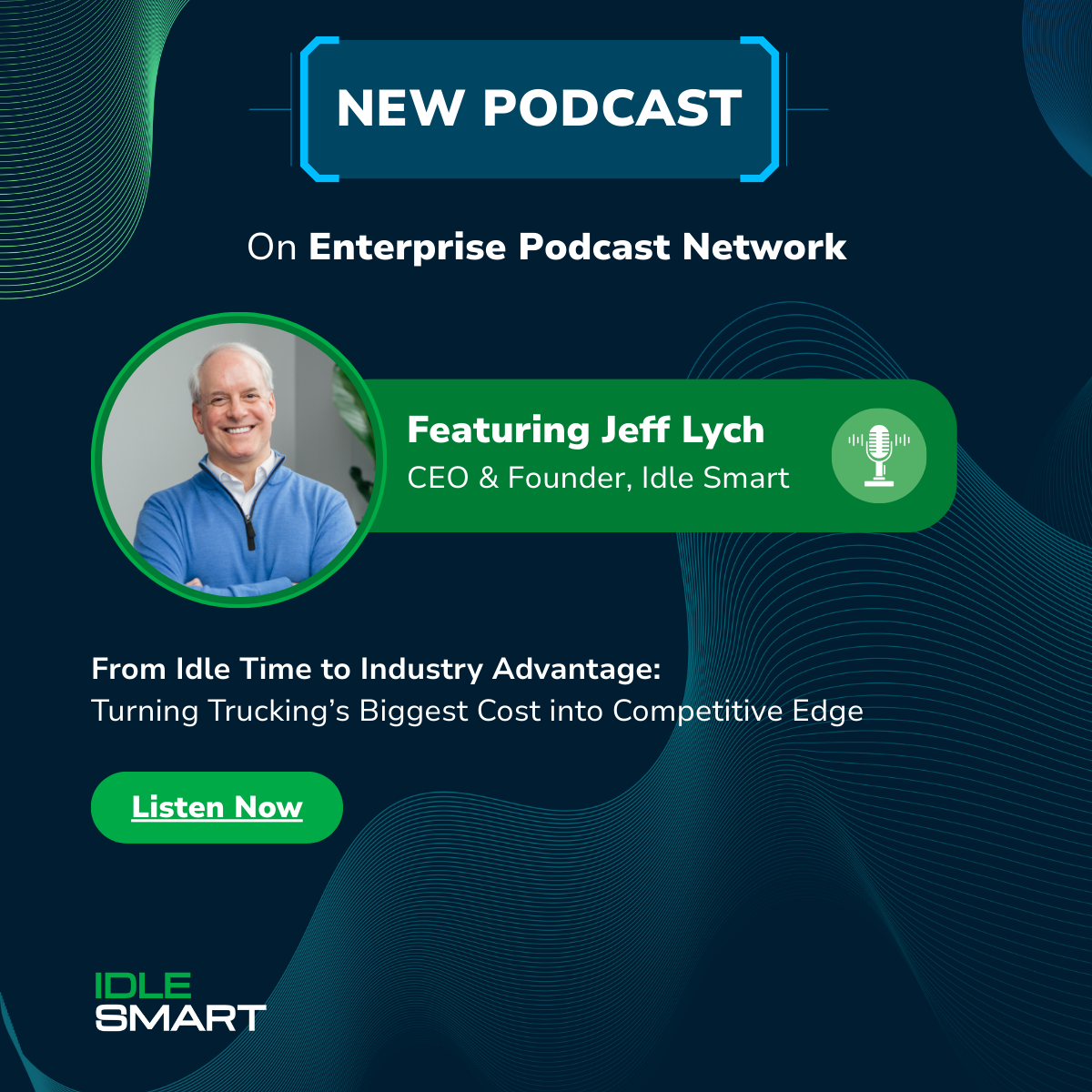
That “background noise” is exactly what Jeff Lynch, Founder and CEO of Idle Smart, couldn’t ignore. In a recent Enterprise Radio interview, Jeff talked about why he built the company and what he’s learned from helping heavy-duty fleets reduce idle time, cut costs, and protect against no-start events, without creating the kind of operational friction that kills adoption. His perspective is simple: fleets need technology that simply just works, and will not fail at 2:00 AM in the cold, when a driver needs it most.
In Jeff’s mind, though, this isn’t a grand disruption narrative. Instead, he sees Idle Smart’s evolution and adoption as a clear-eyed reaction to a problem the industry had stopped challenging. He said he “just couldn’t believe that fleets… were still coming at the idle problem the same way… with really, really expensive solutions.” Not because fleets didn’t care, but because the tradeoffs had been accepted for so long that the conversation stalled at “that’s just trucking.”
Idle Smart, in Jeff’s telling, starts with rejecting that mindset.
Listen to the full interview here:
When a massive cost becomes “normal,” opportunity hides in plain sight
Fleets want to keep drivers safe and comfortable. That’s non-negotiable. The challenge is that comfort has historically come with enormous fuel burn, especially when trucks idle for long stretches, sometimes simply to maintain heat or cooling. Jeff described how easy it is for this to become routine. When the costs are baked in year after year, the industry can stop seeing the waste clearly. That’s not because the impact is small, but instead, because it’s all too familiar.
What Jeff noticed was less about idle time itself and more about how people talked about it. When cost becomes custom, it stops feeling solvable. The result is a steady acceptance of inefficiency, because the alternative often seems worse: driver dissatisfaction, disruptions, unreliable solutions, or enforcement battles that create more problems than they solve.
That’s where innovation starts, Jeff notes. When there’s a willingness to question what everyone else has stopped questioning, breakthroughs happen. When people start looking at a “normal” expense and decide it shouldn’t be normal, innovation thrives.
The difference between a demo and a solution is the real world
Fleet decision-makers don’t need to be told that technology can disappoint them. Many have lived through expensive pilots that looked great in a pitch deck and then failed under real conditions. Jeff acknowledges that skepticism head-on. Fleets have been “burned by technology,” and their first question is often some version of: how is this different from the last thing we bought?
Idle Smart’s response, he notes, anchors on one rule: “technology only works if it works in the real world.” Hardware has to survive high mileage, extreme temperatures, and constant vibration. Systems have to perform at odd hours, in remote locations, and without the luxury of frequent maintenance. Usability has to hold up even when a driver is exhausted, behind schedule, or dealing with a weather event.
That’s why Jeff emphasized a field-first approach: build it, test it in trucks, simplify it, test again, and keep refining until it becomes reliable. The goal isn’t complexity or flash but, instead, to drum up trust earned through repeatable performance across conditions that don’t care how good a solution looks in a conference room.
Listening closely is how operational pain turns into product value
One of the most memorable moments in Jeff’s interview centers on a phrase fleet managers know well: “the $500 turkey sandwich.” It’s a shorthand for a very real operational headache – think dead batteries and no-start events that trigger delays, service calls, and downtime costs that far exceed the original mistake.
What makes the story important isn’t the punchline. It’s the way Jeff describes how the company learned from it. Fleets didn’t come to Idle Smart with a neatly written request for battery monitoring. They talked about the pain in the way people always do: through stories, frustrations, and repeat incidents. Over time, it became clear that no-start prevention wasn’t a side issue; it was central to uptime, driver satisfaction, and cost control.
That’s where listening becomes a strategy. The key isn’t to collect features, it’s to understand what the customer is experiencing, identify patterns, and design automation that removes the failure point without adding steps or complexity. In other words, solve the problem in a way that fits the environment.
Idling isn’t just fuel burn. It’s a signal that operations can use
It’s tempting to frame idling as a discipline issue: reduce it, enforce it, punish it. Jeff suggests something more productive: treat idle time as information. When you look at idling as a signal rather than a moral failing, you start asking better questions. Where is idling happening? When? Under what conditions? Is it weather-driven? Facility-driven? Dispatch-driven? Route-driven?
A good example is a fleet that assumed drivers were idling out of habit. When they dug in, the real cause wasn’t behavior; it was actually their workflow. Drivers were arriving early and waiting, being forced to idle often with no practical alternative. The fix wasn’t punishment; it was better insight and scheduling, combined with the right technology in the truck. When that alignment happened, the results were dramatic, dropping their idle time 40% almost immediately.
Adoption is won by removing inconvenience
In trucking, adoption is the make-or-break factor. Many technologies fail not because they don’t work technically, but because they don’t work socially. Drivers are asked to learn one more system, follow one more rule, manage one more alert, change one more habit, while doing a job that is already physically and mentally demanding.
Jeff’s view is that fleets can’t sell drivers on technology with ROI claims. Drivers aren’t measuring ROI. They’re measuring their day. They assess, he says, “Does it make my day better? Can I drive more miles and earn more money?” That’s the lens drivers use, and it’s the lens any successful fleet technology must respect.
This is where Idle Smart’s design philosophy becomes the core of its adoption strategy. The system is built to be automatic, quiet, and low-friction. It doesn’t require drivers to remember additional steps or manage repeated interruptions. It’s meant to preserve comfort while eliminating waste, so the technology does not become a burden. “People don’t really resist change. What they resist is inconvenience.” Remove the inconvenience, and adoption stops being an obstacle course; it becomes natural.
Sustainability that lasts has to make financial sense
Sustainability came up in Jeff’s interview as something fleets increasingly need to report on, and something that can become performative if it isn’t attached to operational value. Jeff’s stance is pragmatic: sustainability only sticks when it is built into the business model and reinforces profitability and reliability.
Idle reduction is one of the rare levers that can do both at once. Idling less reduces fuel consumption, decreases emissions, and often reduces downstream wear and tear. Preventing no-start events reduces service calls and downtime. When those outcomes live on the same side of the ledger, sustainability stops being a separate corporate initiative and starts being part of how the fleet runs.
Jeff’s summary of the principle is direct: “Sustainability that doesn’t make financial sense, it just won’t scale, but when it does make financial sense, it becomes an unstoppable force.” In other words, sustainability becomes durable when it is also an operational discipline.
Build efficiency now, earn the edge when the market turns
Jeff closed the conversation with a bigger point about resilience. Freight cycles are tough, and downturns pressure fleets to cut. But he argues that the organizations that come out strongest are the ones that continue investing in capability during the hardest stretches, because those improvements compound when the market rebounds.
Idle time is a strong example because it’s both immediate and structural. It delivers savings quickly, but it also strengthens how a fleet operates: less waste, fewer disruptions, better uptime, and more predictable performance. That’s why Jeff framed idle reduction as more than cost-cutting: “Idle time is a great example. It’s not just a cost to cut, it’s a capability to build.”
That’s the heart of the story: fleet advantage doesn’t only come from buying the right equipment or negotiating the right contracts. It comes from building systems that perform consistently, work with drivers instead of against them, and turn everyday inefficiencies into measurable improvements.
Want to explore Idle Smart’s solutions with an expert? Let’s talk.
Contact Us
Let us know how we can reach you, and we’ll be in contact.
"*" indicates required fields