
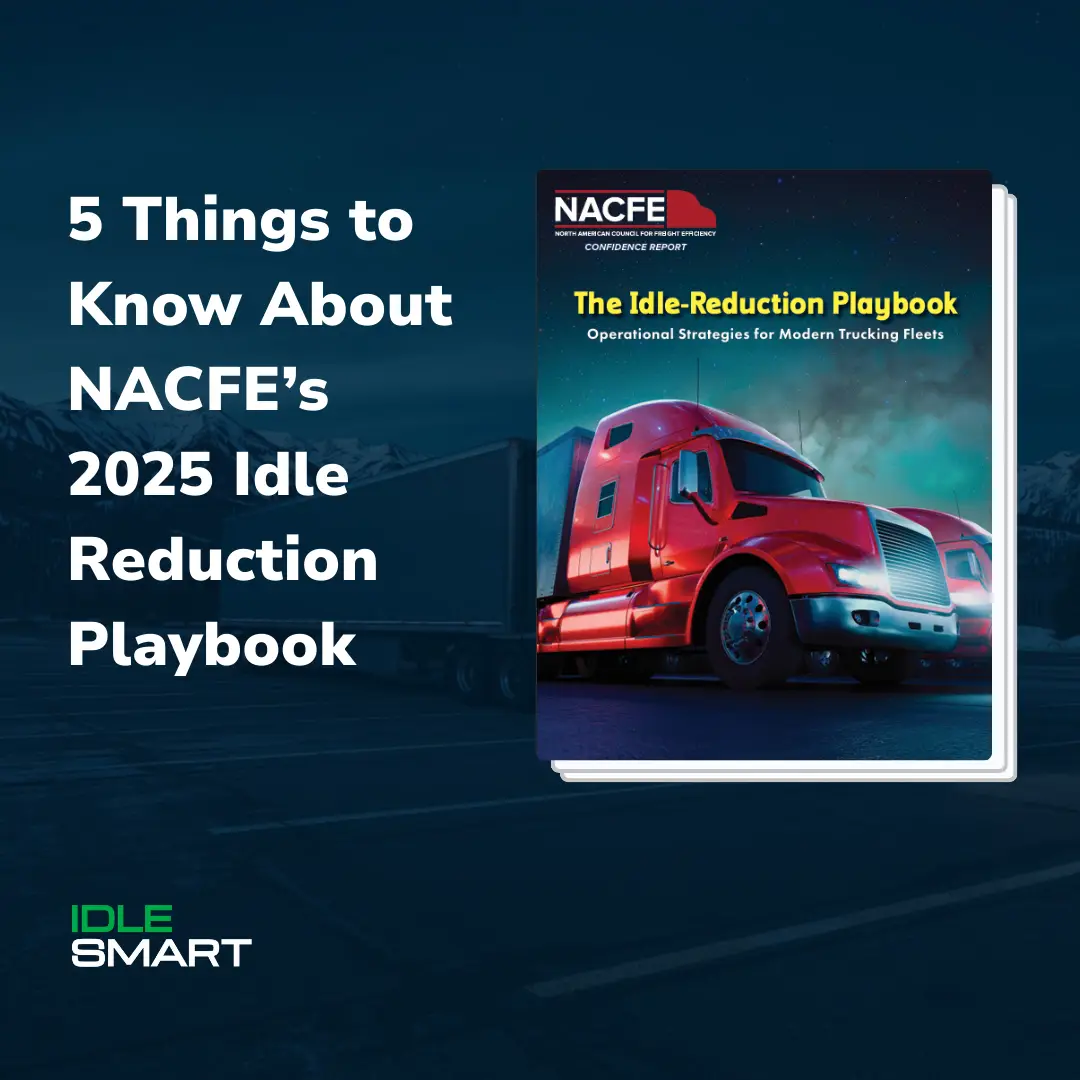
New Year, New Idle Reduction Playbook
The 2025 NACFE Idle Reduction Playbook represents a significant turning point for the trucking industry. While diesel prices averaged $3.81 per gallon in July 2025, the real challenge for executives is the 22% surge in total operational costs over the last two years.
NACFE’s report introduces the era of Technology Convergence, where battery advancements, smart telematics, and automation meet to create a new standard for fleet efficiency.
Here are the five essential takeaways from the report that every fleet leader should know.
1. Idle Reduction is Now “Standard Practice”
Reducing truck idling is no longer a niche sustainability goal; it is a baseline requirement for a competitive operation.
- Adoption Surge: Fuel-efficiency technology adoption rose from 17% in 2003 to 42% in 2023.
- Cost of Inaction: A typical Class 8 truck idles approximately six to eight hours per day, burning 1,000 to 1,800 gallons of diesel annually per vehicle.
- Environmental Impact: Eliminating this excessive idling can avoid up to 15 metric tons of CO2 emissions per truck every year.
2. ROI is Faster, But Payloads Face a “Weight Penalty”
The financial math for idle reduction has never been better, though it requires balancing payload capacity.
- Rapid Payback: Many solutions, such as fuel-operated heaters, offer a payback in well under a year.
- Weight Considerations: Diesel APUs add 400 to 500 lbs to a truck, while eAPU systems add between 345 and 400 lbs.
- Strategic Trade-off: When choosing APUs, leaders must decide if the $3,500 to $6,000 in annual fuel savings per truck outweighs the loss in cargo capacity.
3. Battery Tech is Closing the “Extreme Weather” Gap
One of the historical weaknesses of battery-powered systems (eAPUs) was their inability to last through a 10-hour rest period in extreme heat.
- 10+ Hour Runtimes: NACFE highlights that high-density lithium-ion packs can now reliably provide cooling for 10 to 15 hours.
- The Hybrid Solution: The most effective path forward identified is often a combination of technologies. For example, pairing an eAPU for summer cooling with a fuel-operated heater for winter warmth provides year-round comfort with minimal fuel use.
4. Telematics Has Evolved into “Contextual Management”
The report identifies a shift from more basic systems to Intelligent Engine Management Systems that “understand” the truck’s situation.
- Beyond the Timer: Basic shutdown timers are being replaced by systems that evaluate GPS location, weather, and traffic forecasts before deciding to power down.
- Situational Control: This allows for “smart” idling—permitting an engine to run for a reefer unit or critical hotel load while enforcing a strict shutdown in a terminal or yard.
5. Maintenance Savings: The “Soft Cost” Powerhouse
Perhaps the most important takeaway for maintenance leaders is the impact of idle reduction on engine longevity
- Wear and Tear: One hour of idling is estimated to equal roughly 25 to 30 miles of driving wear.
- Extended Overhauls: Fleets utilizing automated engine shutdown systems have reported 10% to 15% longer intervals between major engine overhauls.
- Protecting the DPF: Minimizing idle time is one of the most effective ways to maintain the health of diesel particulate filters (DPFs), which can cost up to $2,000 per cleaning if clogged.
Bridging the Gap with Idle Smart
While NACFE calls Intelligent Engine Management a “paradigm shift” in idle reduction, fleets using Idle Smart are already executing this playbook. The report specifically notes that fleets using Idle Smart report average savings of $380 per truck per month.
Idle Smart’s automated engine control system directly addresses the “Technology Convergence” NACFE identifies as the future. By automating idle reduction and providing maintenance-free protection against no-starts and fuel gelling, Idle Smart delivers immediate ROI, often paying for itself in less than two months compared to the 18–30 month payback periods typical of bulkier hardware.
The Road Ahead: Technology Convergence
Looking toward 2030, NACFE predicts the industry will reach a state of technology convergence. This includes the integration of solar power, solid-state batteries, and Al-driven predictive management.
For fleets operating today, the 2025 NACFE Idle Reduction Playbook makes it clear: the leaders of tomorrow are those who treat idle reduction as a core component of their data-driven financial and maintenance strategy.
President & Founder
Jeff has led the vision at Idle Smart for over 10 years with a single goal: deliver savings without the hassle. He’s dedicated to building tools that don’t need a manual to understand; just impactful, straightforward solutions worth every dollar. Jeff believes in running a business with the kind of integrity you can shake hands on.
Ready to talk idle reduction with an expert?
Contact Us
Let us know how we can reach you, and we’ll be in contact.
"*" indicates required fields